Showing posts with label folklore. Show all posts
03 August 2012
Exit, Phase Four: Assimilation
A week of recovery in the Uncompahgre Valley and it was time to move again. A week's worth of tacos, big trucks, and patriotism and I was ready to escape to the quieter side of life. With the dog (Hazel) returned to family and the new car (Subaru) returned to family, it was time to hit the highway, dirt roads, and hidden campsites. Time to assimilate.
What we lacked in appropriate camping gear (stove) we made up with accessories (electric scooter, suitcase of books and stuffed animals). Too many accoutrements aside, spirits were high. The last attempt at a car camping road trip didn't fare so well but I was fairly certain that traveling in a more familiar geography was a sure thing.
Loaded with both Minnie's Dreams and the Minnie's Dreams Appendices, as well as the epic, six disc Americana compilation, The Last Living Town, away we went. Chippeha!
Headlong to the heavens.
A torrent of rain within the first thirty minutes made for a wet night in the San Juan Mountains. It's hard to deter a boy's curiosity and imagination, though.
From the West Dolores River it was down and out through Dolores, Dove Creek, then over the border, O Pioneers, into You-tar. With moisture and cool temperatures long gone we found relief in the Dry Wash Reservoir at about 7,000 feet. Swimming in the desert underneath the 11,000 foot Abajo Mountains--or Blue Mountains, depending--is a real treat.
All roads lead to Hank's ville.
The problem with Hanksville is that it's placed in an inferno. At the bottom of the inferno is an illusion of a giant lake. John Wesley Powell knew of no such lake. We paid the ferryman and he took us across Styx.
Hanksville and Henry's Mountains would have to wait. The road to them is straight and narrow and hot and dry. Instead, the shortest distance between an inferno and subalpine shade is a winding, bumpy, dusty road through a Waterpocket Fold in the desert.
The next couple days took us due north and up and over several of Utah's high mountain passes where the near-100 degree temperatures of the valley rose to just over 80. Blissful.
Plans to continue the bliss somewhere up the Huntington Canyon Scenic Byway changed with the 48,000 acre Seeley Fire that burned promising campsites and turned the trout-filled Huntington Creek black. So back down to Huntington to remap and give the kid some fountain time.
Before heading north again I counted five mothers who drove five cars to the fountain with a total of twenty-two kids in tow, a demographic and cultural reminder of the type of country we were traveling through. Then we drove into the appropriately named Carbon County and passed another reminder.
The Castle Gate Cemetery is almost an afterthought now, easily hidden from view and camouflaged by sagebrush and faded stone. Names like Spenoni, Barozzi, Tzanakis, and Georgopoulos account for a different kind of pioneer. Though the 08 March 1924 date on 29 tombstones answer one question, the number of infant and stillborn grave markers testify to the difficult, dangerous, and often lonely lives of both miners and their families that relocated to a foreign country in search of something better than what they left behind.
Up and over more mountain passes until we entered the southwestern flanks of the Unita Mountains, the highest east-west running range in the contiguous United States. It was time to hunker for a couple days and, besides that, I knew the headwater forks of the Duchesne River teem with cutthroat trout. Camp was set, dads took pictures of sons, sons took pictures of dads, and we fished for two days straight.
Leaving the Unitas and more reminders, this time that inhabitants of the contemporary Western landscape aren't always as compatible as those we often emulate.
The Five Suns is a creation myth of the Aztec and other central Mexican peoples. The previous four worlds, or Suns, have long been destroyed by the faults and arrogant actions of presiding deities. The Fifth Sun, the present world, is supported by the Aztec themselves whose divine duty is to nourish Huitzilopochtli, the god of war, with sacrifices. Should the sacrifices fail, Coyolxauhqui, the goddess of the moon and a black magician, would defeat the sun god. If this happens, the Fifth Sun will be cast into darkness and a giant earthquake will spell the end of the Earth and all of humanity. Until then we'll make massive wrought iron monuments to ourselves and spray sagebrush with all the water we cannot afford to lose.
Water is a recurrent theme of desert travel and as we inched our way into the upper northeastern corner of the Great Basin water seemed more abundant, pastures greener, and friends more friendly. The swimming was good and so were the key lime pie shakes, cold cans of Coors, and backyard BBQs.
From Utah we entered the home stretch out of the Great Basin and into the Snake River Plain and its various tributaries of Idaho. It is here where we will stay.
The rest of the summer will focus on settling and assimilating back into something more recognizable and familiar than the intensive immersion course of the last ten years. It's good to touch the green, green grass of the desert. For now.
30 May 2012
Exit, Phase Two: Refocus
RIP Arthel Lane "Doc" Watson
(3 March 1923 – 29 My 2012)
Doc Watson was a tradition bearer and a national treasure. Within his sightless body was stored the histories, stories, cultural values, attitudes, and belief systems of numerous generations of Americans who made their way in and out of the area around Deep Gap, North Carolina. He was the seed tree in a productive orchard whose roots grew the deepest and whose branches bore the sweetest fruit. He learned from the best (Clarence Ashley, Gaither Carlton, Uncle Dave Macon, Mississippi John Hurt) and transferred his knowledge to teach some of the best (Clarence White, Ricky Skaggs).
In 1997 Doc Watson won the National Medal of Arts, the highest award given to artists by the United States Government, and was presented to him by President Bill Clinton. Other recipients of this lofty award have included Al Pacino, Andrew Wyeth, Ella Fitzgerald, and Aaron Copland. In 1988 Doc Watson received a more humble but no less important National Heritage Fellowship awarded by the National Endowment for the Arts. Alongside Doc Watson were other not so well-known tradition bearers as Kepka Belton, a Czech-American egg painter; Amber Densmore, a New England quilter/needleworker; Willa Mae Ford Smith, a gospel singer from St. Louis; and Michael Flatley an Irish-American stepdancer.
Like Doc Watson these people represent masters of their craft, interpreters and innovators of their chosen art form. Equally, the tradition bearer serves to connect links between the craft and the communities from which they emerge. These masters act to preserve certain traditions as custodians but through performance they also transmit and solidify the life of the expressive craft. They are key participants in the complex web of any culture's past, present, and history and with the passing of Doc Watson our country just lost something essential.
08 November 2011
Idahome
Apparently change is good. It better be because it's about to happen again. Three and a half years in Switzerland, three in Chile, a year in Kazakhstan, two in Mexico, a couple other places scattered here and there, and come this July all roads will point back home, or at least a version of home in a part of the world I know the best. In July 2012 this piece of property--its physical walls, floors, and ceiling, as well as its history and the stories, people, places, and things that have passed through its doors--will constitute my work for at least a year's time.
Part restoration, part documentation, part research and fieldwork, part exhibit, the project will focus on a 19th century homestead in a remote part of south central Idaho. The project will provide the framework, the daily schedule, for a year. Beyond the project, the year spent in a place, area, or region that I can only generally describe as home will help to redefine and reacquaint me with what I think I know and also don't know about myself. I will have a job to do next year, and a limited time to do it, but the secondary function of next year will be to sink my feet deep in a landscape and culture that for a good ten years has existed only as memories.
Living abroad has taught me many things, maybe most importantly are the reasons I love the country and place where I was born, both as a physical and ideological space. However, reasons, though hopefully based on sound judgement, can be ephemeral. Reasons distort over time, change over time, even sometimes prove false over time. Do I love the place where I'm from, am I still connected to it, or am I in love instead with an idea I have formed after living apart from it for so long? Will the idea stand up to the reality? Probably not entirely. Will I be capable, then, of adapting to the reality? Hard to tell.
It's the whole Thomas Wolfe "you can't go home again" syndrome not uncommon to expats and others living far away for long periods of time. In the novel of the same name Wolfe writes:
You can't go back home to your family, back home to your childhood, back home to romantic love, back home to a young man's dreams of glory and of fame, back home to exile, to escape to Europe and some foreign land, back home to lyricism, to singing just for singing's sake, back home to aestheticism, to one's youthful idea of 'the artist' and the all-sufficiency of 'art' and 'beauty' and 'love,' back home to the ivory tower, back home to places in the country, to the cottage in Bermuda, away from all the strife and conflict of the world, back home to the father you have lost and have been looking for, back home to someone who can help you, save you, ease the burden for you, back home to the old forms and systems of things which once seemed everlasting but which are changing all the time--back home to the escapes of Time and Memory.
You can't go back home. You can't go back to a place that once seemed permanent, unchanging, and, in its permanence, meaningful but which, in fact, was "changing all the time." Maybe. Maybe I'll sink my feet and not feel comfort. Maybe I won't recognize that which I thought I knew. Once uprooted, maybe the only way to survive is to graft onto something else and hope that some other rootstock is capable of supporting another life. Luckily, for me, I'm interested enough in this idea that I'm willing to experiment, give it a shot with the consequence that at the very least the change will offer yet another series of experiences in a long list of speculative adventures. Ultimately, why not?
I look forward to it. I look forward to seeing friends and family I haven't seen in years. I look forward to open spaces, dry air, and endless expanses of sagebrush. I look forward to daily runs to the top of Kelly Springs or up the East Fork. I can't wait to ski Lizzie's Bowl, Buck's Choice, White Wine, or off the backside of Pine Mountain again, places where you're more likely to ski with antelope or elk than you are other skiers. And I already envision fishing my favorite spots on the... well, let's just say on some of the lesser-known rivers and streams surrounding the area. No need to disclose too much information.
Home might be more a state of mind than a fixed place. Maybe home represents a collective ideal of place, relations, history, landscape, culture, occupation, and any number of other factors. Maybe home is a single ideal and maybe it's a series of ever-evolving memories and wishes. I don't really know. Right now, all I know is that within a year I will leave, once again, a place I could never consider home and return to another place that in ten years, in many ways, I never left.
31 August 2011
On the Road to Find Out 3
(Continued from Part 2.)
With only a few days to spare after returning from Lucca, the family--this time the whole family including Hazel Dickens and Annabelle Lee--hit the road again. The itinerary was short and fast and would eventually turn a bit intense. We were to drive to Luzern and overnight with our long-time friends Monika and Christen. From there we would take the train to Engelberg, the bus to the Luftseilbahn that would take us up to the Fürenalp. From the Fürenalp we'd hike a few hours up valley and stay overnight at the Blackenalp. The next day we would continue up the valley and cross the Surenenpass which would take us along a lengthy ridgeline to the enclave of Brüsti. From there, natürlich, we would take a cable car back down to Attinghausen, bus into Altdorf, and then take a train back to Luzern. Kein problem! Genau.
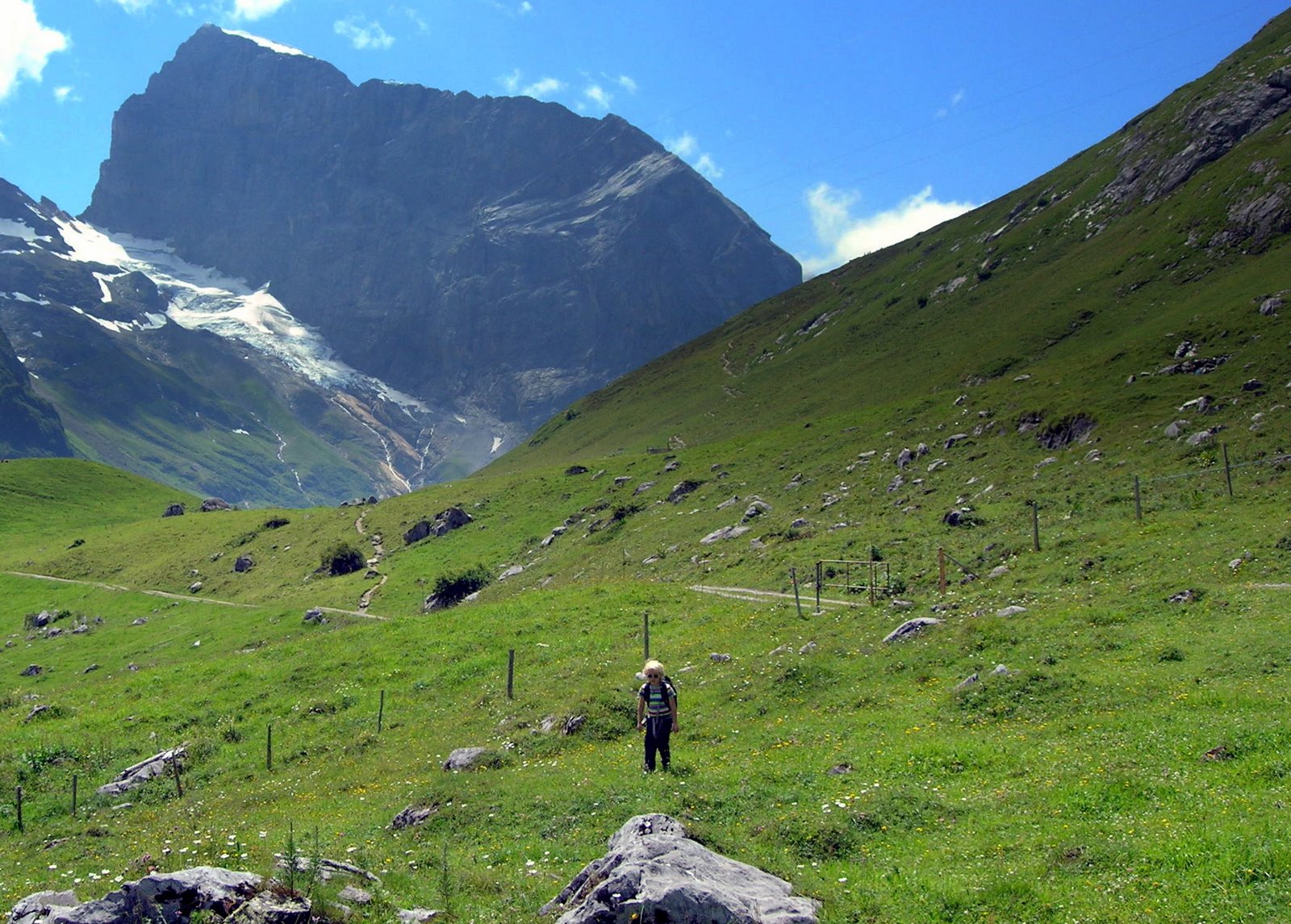
Saturday was perfect. The day pretty much summarized everything that you imagine as Switzerland: blue skies, a few puffy white clouds, green alpine pastures and valleys, melting glaciers, blonde children, happy dogs. Fresh milk. That sort of thing.
For the most part the day progressed as planned. We were excited for Hank who, though he has been hiking for a few years now, hasn't been on an overnight backpacking trip, albeit a backpacking trip without much in your backpack as well as the benefit of a roof over your head, full meals, and a bar waiting for you at the end of the day. We meandered, stopped for a picnic, and spent the first day at a leisurely pace.
At about the halfway point we heard a kind of scream, a maniacal yell of sorts, that finally and completely took our minds and bodies off the busy streets of Luzern, away from the hordes of tourists in Engelberg, and even far from the beer-drinking, sausage-eating crowds who would venture no farther than the restaurant at the top of the Fürenalp. The maniacal yell sounded something like this and was followed by the sound of a giant zipper opening above our heads and for the next 36 hours or so contemporary Switzerland would remain 3,000 feet and at least a hundred years below us.
What sounds totally bizarre in fact is totally bizarre but is also an example of traditional Swiss alpine customs and practices still in action. Turning our heads upward revealed the source of the zip noise: a long cable rising about 1,000 feet from a grassy knoll to a higher, less accessible notch of a pasture at the top of a cliff band. Hovering above us, riding the cable down to the knoll, was a hand cut bale of hay. The maniacal yell was a fairly typical call of an alpine herdsman used, in this case, as a warning that a new hay bale was being released from above.
Another two hours brought us to our destination for the night: the Blackenalp. An alp is a remote working farm used primarily in the summer by a herdsman and his helpers. It also doubles and triples as an inn for trekkers as well as a place to find a hot meal and a cold drink. Included with the price of a bed is dinner and breakfast the following morning. Switzerland and the rest of the Alpine countries are so dotted with these inns, chalets, huts, and/or refuges that it's possible to link up an entire summer of crossing up and over high altitude passes and country borders without ever dropping down into the valleys to stock up on supplies. It's a great way to experience the (semi) solitude of backpacking without packing quite as much stuff on your back.
The Blackenalp consists of a barn equipped with milking stalls--used twice daily--a main building with upstairs room for maybe thirty travelers, a large dining room, large kitchen and workspace for cheese and butter production, and a partially buried cellar for all things dairy. Separated from the main buildings on a grassy knoll is a small chapel (room for twelve) whose bells are rung every night as a show of appreciation for the day's work.
The smell of rich, grassy milk permeates the Blackenalp and, indeed, is the reason for its existence. Though the herdsman watches over a total of about 500 head of livestock, split between cows and calves, steers, and sheep, the profits from milk, cheese, and butter go straight into the his pocket. Income is also generated through money collected from trekkers for room and board and additional sales of food and drink. The bulk of the herdsman's income, however, is paid to him by a local cooperative of livestock owners who hire him to tend their animals for the summer. The Blackenalp itself is under the ownership of the cooperative who, in turn, lease their high valley pastures from the State. Not a money-making proposition--at least for the herdsman and his assistants--but this is also why so many traditional customs, practices, and rituals still persist.
For example, there are few things more traditional than the food the alpine herdsmen eat and for our night's stay at the Blackenalp we were treated to the most traditional of traditional meals: Älplermagronen and fresh Apfelmus!
What else could a person who is surrounded by fresh, flowing milk afford to eat and feed his help that wouldn't significantly cut into his profits? Pasta, potatoes, onions, cheese, butter, and sour cream, of course. Smash a whole bunch of apples that were hauled up on the last supply run and you've got yourself a meal that will fill the belly and knock you down for the night. Wake before dawn, eat a bunch of fresh cheese, butter, and warm bread, wash it down with instant coffee and head out on your four-hour romp around the entire valley to check the livestock. Return to milk the morning cows, work on projects around the property for the afternoon, then leave again for a second four-hour trip around the valley. As soon as the second check is completed the evening cows need milked. At dusk the Älplermagronen and Apfelmus is placed on the dinner table, devoured, and followed by more instant coffee and a glass or two of schnapps. The day's work is done; the life of a Swiss herdsman is a series of ancient rituals.
The next morning we said goodbye to the Blackenalp under cooler temperatures and a changing sky. Within a half-hour a light mist fell and it appeared that we wandered out of Switzerland and straight into the Scottish Highlands.
For the rest of the day the clouds and rain would not lift and would only grow in intensity once we crossed over the Surenenpass and walked toward Brüsti. Pretty, but with a seven year-old to keep happy and positive, constant rain quickly loses its appeal.
Two hours of climbing took us to the Surenenpass. It was here, less than halfway through the day, when the skies opened up in earnest. We took a quick break in the Schutzhütte before launching into another three hours of non-stop rain.
I kept the Lovin' Spoonful on a constant loop in my head. This helped keep the bad spirits away. But it wasn't me I was worried about. Hank did well going down off the pass and even for a while on the long ridgeline to the Brüsti. Five hours of walking in the rain is a lot to ask of a seven year-old--hell, it's a lot to ask of a 42 year-old. Without a tree in sight, without any more huts to take shelter for a while, moods inevitably deteriorate. And they did. And it was difficult.
Persevere he did and eventually we made it to Brüsti and the Berggasthaus Z'graggen was open and the tears stopped falling. Henry drank the two best hot chocolates of his life, his parents and friends drank eight or so Kaffee fertigs (coffee and schnapps), and we rested an hour before the cable car took us back to the lowlands.
In Altdorf we waited for a bus (in the rain) in the city's main plaza. Altdorf is home to the great Swiss patriot and assassin, William Tell. William the brave. William the bold. William the expert marksman. William who broke the rules and was forced to shoot an apple off his son's head for doing so. He did (natürlich!) and was sent to jail for his feat. In a storm on Lake Lucerne he escaped his captors and returned to assassinate the tyrannical Austrian overlord, Albrect Gessler. William's defiance and bravery started a rebellion in the Canton of Uri that eventually led to the formation of the Swiss Confederation. Pretty dramatic stuff though a distant memory from the quiet as a mouse, passively aggressive Switzerland of today.
As is the case with any good legend, the legend of William Tell doesn't quite match the history records. William Tell could have been a real person; he also could have been an amalgamation of several people. The William Tell legend belongs to a group of mostly German, Scandinavian, Danish, English, and even Balkan folk legends that the folklorist Stith Thompson gathered together in the famous Motif Index under the title "Skilful marksman shoots apple from man's head." What this means is that legends with different characters and place names but similar in that they all contain the "apple-shot" motif had been circulating orally for hundreds of years before surfacing in central Switzerland with William Tell as the hero and the Austrian Habsburg overlord as the villain.
Does that mean that William Tell didn't exist? No. Does that mean that he didn't perform the actions according to the legend? No. What it usually means is that over time, starting in the mid-15th century, at least some if not all of the storyline has been altered or modified to meet the cultural, political, and social values of the Swiss citizens. The fact that a statue stands in the middle of Altdorf and stories continue to circulate demonstrates that the legend of William Tell is still a narrative depiction of Swiss values and effects the way the Swiss view themselves in relation to others.
No matter. At five o'clock on a Sunday evening, soaked to the bone and with the rain still falling, even I wasn't that interested in how a 500 year-old legend still determines the value system of a small European country. All we wanted was a warm shower, dry clothes, and a hot meal. In three hours time those tasks were complete. In five hours we were driving back to Geneva.
At some point along the way, Fred Neil played from a compilation CD I had in the stereo. The weather had cleared (natürlich) and in front of us the last brilliant sliver of bright orange hung on to the far western tops of the Jura Mountains. It was a bright, deep, rich orange, the kind of sunset that only appears after an all-day cleansing of the atmosphere. The rest of the family, including the dogs, had long since passed out and I was left alone to the end of a beautiful day and the voice of Fred Neil.
(Continue to Part 4.)
31 July 2011
Swissness
Happy 720th birthday Switzerland!
My, my, you've come a long way. What have you learned in your 720 years? How is the Switzerland today different from the Switzerland of yore? Well, as the old saying goes, you can tell a lot about a country by reading their dress code manuals. The following was taken from the July 2011 issue of Harper's Magazine.
(From a forty-three-page dress code given to employees of Swiss bank UBS last year. Translated from the French by Anthony Lydgate.)
In general, a blouse is worn with a jacket. When it gets very hot and you have received approval from your immediate superior, you many wear just a blouse with pants or skirt.
The scarf must always be folded and tied with the knot oriented not down but, as much as possible, up and to the left.
Under no circumstances should the point of your tie enter your pants.
To improve your comfort, you may use "Party-Feet" silicone inserts, for example when you walk on hard surfaces.
Allow your shoes a respite equivalent to twice the time of their use.
The wearing of ultra-trendy glasses is not allowed. Also see to it that your jewelry matches the metallic color of your frames.
A man who wears a watch conveys reliability and a great concern for punctuality.
Light day makeup composed of foundation, mascara, and discreet lipstick goes well with the dress code and will highlight your personality.
The skin being our primary item of clothing, we recommend that you protect it by applying a nourishing, soothing cream.
Never massage an area where you have applied perfume, as this can destroy its molecules.
Studies have shown that a stylish, immaculate haircut considerably raises individuals' likeability.
Every little hair that grows on the body has a function. The eyebrows protect the eyes from sweat and the eyelashes keep out dust and little insects. Stray facial hairs, however, upset one's overall look and ought to be avoided.
Never wear shoes that are too small for you: there's nothing worse than a pinched smile.
Apparently, UBS CEO Oswald J. Grübel didn't read the manifesto. Maybe the UBS employees could pool some funds and buy Oz a larger pair of shoes.
To observe a country through their dress codes, though, is possibly too limited. I mean, not everyone in Switzerland is a banker, some are even lawyers, and you haven't seen racy until you've stepped into a Swiss courtroom. Maybe we need to widen our scope and look at the politics that run the country. Then we'll have a better idea of the current state of the nation.
The increasingly popular Swiss People's Party (SVP in German, or UDC in French) issued the following internet ad campaign late last year.
The ad is offensive on several levels but let's stick to the intended message: In 2010, Lake Zürich (Zürisee) is clean and pure and encourages white-skinned women with many different hair colors to rub their butts on its shore before standing hand in hand and wading into its water. If mass immigration isn't stopped, and I mean, like, today, in twenty years time Lake Zürich will transform into a filthy bathtub for countless overweight, Muslim, gypsy (Roma), and North African women.
An official political party only since 1971, the SVP's roots dig back to the early 1930s when it sought to represent farmers and other rural Swiss citizens. Until the 1990s (Wait, when was the war in the Balkans that produced the Yugoslav diaspora?) the party maintained a modest popularity percentage and minimal political influence. With the help of billionaire Christoph Blocher, the SVP is now the most powerful political party in the country, owning some 58 out of 200 seats in the National Assembly.
These days, besides giving the finger to the EU and trying to repeal the Schengen Agreement, the SVP builds higher and higher mountains (read: walls) around Swiss borders. Publicly, this takes the form of political posters that frighten, intimidate, and forebode the future of Switzerland if it continues to allow, among other things, loose immigration standards.
Examples include the fuzzy white sheep kicking out fuzzy black sheep:
Then there are evil black ravens that peck away and abuse the country (notice the Clear Channel company tag at the top of the billboard):
Next we have several beige to black hands freely grabbing highly desired and extremely difficult to obtain red Swiss passports out of a box:
Will Ivan the rapist soon be Swiss?
And the granddaddy of them all, the one that helped influence the 57% vote to ban the construction of new minarets:
On this last poster it's important to keep in mind that while Switzerland is home to about 400,000 Muslims, about the same number as in New Jersey but with a land mass of about twice the size, there is a grand total of four minarets. Four, and there will be no more.
Tricky times for a country as old as the hills. Problem is, for a country that would like to see itself as clear and clean as the water in Lake Zürich, that would like to convey "reliability and a great concern for punctuality," Switzerland is far from homogenous. With four official languages (German, French, Italian, and Romansh) and an infinite number of dialects, diversity has been implicit from the very beginning.
Switzerland claims the highest portion of permanent foreign residents in Europe (22%), two-thirds of whom come from other European countries. Islam accounts for the largest religious minority which is roughly one-twentieth of the total population. If ethnicity, language, and religious beliefs form the core of a unified country then Switzerland is less a nation in the geographical sense than a collection of citizens with similar values and assumptions living within a vaguely demarcated land area. Probably, the shrewd Schweizer would say just that: Yes! That is exactly what we are fighting for: Swiss values!
What, exactly, are Swiss values?
Back in 1291, members of three tribes from what are now the cantons of Uri, Schwyz, and Unterwalden met at the Rütli meadow and signed an oath of confederacy that eventually became what is known as the Old Swiss Confederacy. When the Federal Charter was created, I can't imagine the citizens had much in common with each other apart from their beards, love of all things lactic, and fear of Tyrannosaurus rex or whatever else hunted them. And in 2011, besides one of the strongest currencies in the world, what does an Italo-Romansh speaker in mountainous Ticino have in common with a Swiss-German speaker in agricultural Schaffhausen? The same love of dairy products? Definitely. A nice pension plan? Yep. The feeling of being surrounded by an increasingly hostile and out of control European Union? Loneliness?
According to a SVP flyer that appeared in the mailbox recently, what all Swiss citizens have in common at the moment is a problem with mass immigration. According to the flyer:
Nous avons néanmoins perdu notre autodétermination dans un domaine important: la Suisse a abandonné progressivement au fil des années passées le contrôle de l’immigration des étrangères et étrangers. Nous voyons et ressentons tous les jours les effets de ce développement: routes bouchées et transports publics bondés, difficulté croissante de trouver un logement et, partant, prix excessifs des loyers. Nombre de Suissesses et de Suisses ne peuvent plus payer des locations aussi élevées. La concurrence sur le marché du travail est de plus en plus rude. Les immigrants en provenance de l’UE évincent dans plusieurs branches les ressortissants d’Etats tiers qui tombent ensuite à la charge de notre système social. La criminalité étrangère et les abus dans le droit d’asile font partie du quotidien.
A rough translation tells us that Switzerland has lost its self-determination in one important area: the Swiss have gradually abandoned immigration control of foreigners and strangers. Every day, Switzerland sees and feels the effects of this predicament: clogged roads and crowded public transport, increased difficulty finding housing and, thus, excessive rents. Swiss citizens can no longer afford such high rents. Competition in the labor market is increasingly fierce. Immigrants from several areas in the EU displace third-country nationals who then become expenses of the social system. Foreign crime and abuse are part of everyday life. End of rough translation.
The story goes that the mountain people from Uri, Schwyz, and Unterwalden joined forces part and parcel to protect themselves from the Habsburgs running rampant through the countryside. In a sense, they formed their pact out of fear. Fear of being trounced by someone else and assimilated into something not within their own control. Today, the Swiss are asked once again to join forces in order to stop an outbreak of immigrants with, apparently, values much different than those of the multi-lingual, multi-ethnic nationals. Are the European Union and others not so unionized the Habsburgs of today? Is fear, then, the foundation of the Swiss value system?
If you were to summarize the messages in the series of political posters created by the Swiss People's Party which, of course, is the point of political posters--to pique or alarm the value system of the onlooker--then you might come up with a collection that includes the aforementioned categories of religious beliefs, ethnicity, language, and crime.
What a Swiss citizen wants, perhaps, is a country of Swiss people, a country of white things (either women or sheep), with no more than a few official languages, and maybe one or two religious preferences. You know, the way Switzerland used to be. In addition, there should not be people in Switzerland who commit crimes--crimes of abuse, theft, rape, or violence of any kind.
Those are fairly straightforward values, aren't they? And, you have to admit, if you're going to deal with criminals--and in one way or another we all deal with criminals--you might as well make some decent money off them. Why bother with petty gypsy pickpockets when Muammar Gaddafi, Hosni Mubarak, and Zine al-Abidine Ben Ali are part of your client base? Okay, conceivably a caveat of the Swiss value system is that they are free to pick and choose what value system they would like to value.
In the end, maybe it does come down to dress codes and the way others perceive the Swiss in public. Look good, stay fit, keep your tie out of your pants, match your jewelry with your metallic glasses, and the world won't notice the ripples you make as you wade into that chilly, glacial lake of your ancestors. Out with the burka, in with “Party-Feet”! Out with your minarets, but your bank accounts lend a sophisticated green hue to the pastoral landscapes.
Ripples. Never, never let them see your ripples. Repeat this mantra and there is no doubt that when it comes to raising the likeability of individuals, four sandy bums beat one Ivan the rapist every time.
Then again:
Happy birthday, Switzerland, may you quietly pass the world by for another 720 years. But watch out for that black boot behind you.
Credits:
Oswald J. Grübel
Swiss population statistics
All political poster photos came either from the SVP website or other news affiliations.
Subscribe to:
Posts (Atom)