The morning I woke up, Metaphor was laying next to Dellwood's fire bed, frozen.
I saddled up Abraham Lincoln and Killdeer and started riding. No tracks to follow, I rode north and west. Rode with the firewater brandy, rode into the Craters of the Moon. Lava rock, snow and ice, slabs of Indian warriors, wind.
Rode in circles. Kept going. Going where I didn't know. Ten more feet. One step at a time.
I pulled my hat down and covered my face with the scarf I'd made two holes in, and wore the blind man's glasses. Yellow snow--a world of yellow snow.
Mountain peaks growing into other mountain peaks. The crooked trail not a trail at all except that we were following it, sometimes the path no wider than Killdeer and Abraham Lincoln, my feet sticking out over the forever blizzard going down.
Nights by the fire, red-under-black embers at my head, moon at my eyes. I did not close my eyes. Did not open them.
No single intention.
No Dellwood's shiny dime.
My errant knight.
My little pip.
My brave hero.
--Tom Spanbauer, from The Man Who Fell in Love with the Moon, 1991
Mont Blanc: Lines Written in the Vale of Chamouni
I
The everlasting universe of things
Flows through the mind, and rolls its rapid waves,
Now dark--now glittering--now reflecting gloom--
Now lending splendour, where from secret springs
The source of human thought its tribute brings
Of waters--with a sound but half its own,
Such as a feeble brook will oft assume,
In the wild woods, among the mountains lone,
Where waterfalls around it leap for ever,
Where woods and winds contend, and a vast river
Over its rocks ceaselessly bursts and raves.
II
Thus thou, Ravine of Arve--dark, deep Ravine--
Thou many-colour'd, many-voiced vale,
Over whose pines, and crags, and caverns sail
Fast cloud-shadows and sunbeams: awful scene,
Where Power in likeness of the Arve comes down
From the ice-gulfs that gird his secret throne,
Bursting through these dark mountains like the flame
Of lightning through the tempest; thou dost lie,
Thy giant brood of pines around thee clinging,
Children of elder time, in whose devotion
The chainless winds still come and ever came
To drink their odours, and their mighty swinging
To hear--an old and solemn harmony;
Thine earthly rainbows stretch'd across the sweep
Of the aethereal waterfall, whose veil
Robes some unsculptur'd image; the strange sleep
Which when the voices of the desert fail
Wraps all in its own deep eternity;
Thy caverns echoing to the Arve's commotion,
A loud, lone sound no other sound can tame;
Thou art pervaded with that ceaseless motion,
Thou art the path of that unresting sound--
Dizzy Ravine! and when I gaze on thee
I seem as in a trance sublime and strange
To muse on my own separate fantasy,
My own, my human mind, which passively
Now renders and receives fast influencings,
Holding an unremitting interchange
With the clear universe of things around;
One legion of wild thoughts, whose wandering wings
Now float above thy darkness, and now rest
Where that or thou art no unbidden guest,
In the still cave of the witch Poesy,
Seeking among the shadows that pass by
Ghosts of all things that are, some shade of thee,
Some phantom, some faint image; till the breast
From which they fled recalls them, thou art there!
III
Some say that gleams of a remoter world
Visit the soul in sleep, that death is slumber,
And that its shapes the busy thoughts outnumber
Of those who wake and live. I look on high;
Has some unknown omnipotence unfurl'd
The veil of life and death? or do I lie
In dream, and does the mightier world of sleep
Spread far around and inaccessibly
Its circles? For the very spirit fails,
Driven like a homeless cloud from steep to steep
That vanishes among the viewless gales!
Far, far above, piercing the infinite sky,
Mont Blanc appears--still, snowy, and serene;
Its subject mountains their unearthly forms
Pile around it, ice and rock; broad vales between
Of frozen floods, unfathomable deeps,
Blue as the overhanging heaven, that spread
And wind among the accumulated steeps;
A desert peopled by the storms alone,
Save when the eagle brings some hunter's bone,
And the wolf tracks her there--how hideously
Its shapes are heap'd around! rude, bare, and high,
Ghastly, and scarr'd, and riven. Is this the scene
Where the old Earthquake-daemon taught her young
Ruin? Were these their toys? or did a sea
Of fire envelop once this silent snow?
None can reply--all seems eternal now.
The wilderness has a mysterious tongue
Which teaches awful doubt, or faith so mild,
So solemn, so serene, that man may be,
But for such faith, with Nature reconcil'd;
Thou hast a voice, great Mountain, to repeal
Large codes of fraud and woe; not understood
By all, but which the wise, and great, and good
Interpret, or make felt, or deeply feel.
IV
The fields, the lakes, the forests, and the streams,
Ocean, and all the living things that dwell
Within the daedal earth; lightning, and rain,
Earthquake, and fiery flood, and hurricane,
The torpor of the year when feeble dreams
Visit the hidden buds, or dreamless sleep
Holds every future leaf and flower; the bound
With which from that detested trance they leap;
The works and ways of man, their death and birth,
And that of him and all that his may be;
All things that move and breathe with toil and sound
Are born and die; revolve, subside, and swell.
Power dwells apart in its tranquility,
Remote, serene, and inaccessible:
And this, the naked countenance of earth,
On which I gaze, even these primeval mountains
Teach the adverting mind. The glaciers creep
Like snakes that watch their prey, from their far fountains,
Slow rolling on; there, many a precipice
Frost and the Sun in scorn of mortal power
Have pil'd: dome, pyramid, and pinnacle,
A city of death, distinct with many a tower
And wall impregnable of beaming ice.
Yet not a city, but a flood of ruin
Is there, that from the boundaries of the sky
Rolls its perpetual stream; vast pines are strewing
Its destin'd path, or in the mangled soil
Branchless and shatter'd stand; the rocks, drawn down
From yon remotest waste, have overthrown
The limits of the dead and living world,
Never to be reclaim'd. The dwelling-place
Of insects, beasts, and birds, becomes its spoil;
Their food and their retreat for ever gone,
So much of life and joy is lost. The race
Of man flies far in dread; his work and dwelling
Vanish, like smoke before the tempest's stream,
And their place is not known. Below, vast caves
Shine in the rushing torrents' restless gleam,
Which from those secret chasms in tumult welling
Meet in the vale, and one majestic River,
The breath and blood of distant lands, for ever
Rolls its loud waters to the ocean-waves,
Breathes its swift vapours to the circling air.
V
Mont Blanc yet gleams on high: the power is there,
The still and solemn power of many sights,
And many sounds, and much of life and death.
In the calm darkness of the moonless nights,
In the lone glare of day, the snows descend
Upon that Mountain; none beholds them there,
Nor when the flakes burn in the sinking sun,
Or the star-beams dart through them. Winds contend
Silently there, and heap the snow with breath
Rapid and strong, but silently! Its home
The voiceless lightning in these solitudes
Keeps innocently, and like vapour broods
Over the snow. The secret Strength of things
Which governs thought, and to the infinite dome
Of Heaven is as a law, inhabits thee!
And what were thou, and earth, and stars, and sea,
If to the human mind's imaginings
Silence and solitude were vacancy?
--Percy Bysshe Shelley, 1817
From the high ridges right down to the level of the road, there was snow all over the Ruby Mountains. "Ugh," said Deffeyes--his comment on the snow.
"Spoken like a skier," I said.
He said, "I'm a retired skier."
He skied for the School of Mines. In other Rocky Mountain colleges and universities at the time, the best skiers in the United States were duly enrolled and trying to look scholarly and masquerading as amateurs to polish their credentials for the 1952 Olympic Games. Deffeyes was outclassed even on his own team, but there came a day when a great whiteout sent the superstars sprawling on the mountain. Defffeyes' turn for the slalom came late in the afternoon, and just as he was moving toward the gate the whiteout turned to alpenglow, suddenly bringing into focus the well-compacted snow. He shoved off, and was soon bombing. He was not hurting for weight even then. He went down the mountain like an object dropped from a tower. In the end, his time placed him high among the ranking stars.
Now, in the early evening, crossing Independence Valley, Deffeyes seemed scarcely to notice that the white summits of the Ruby Range--above eleven thousand feet, and the highest mountains in this part of the Great Basin--were themselves being reddened with alpenglow. He was musing aloud, for reasons unapparent to me, about the melting points of tin and lead. He was saying that as a general rule material will flow rather than fracture if it is hotter than half of its melting point measured from absolute zero. At room temperature, you can bend tin and lead. They are solid but they flow. Room temperature is more than halfway between absolute zero and the melting points of tin and lead. At room temperature, you cannot bend glass or cast iron. Room temperature is less than halfway from absolute zero to the melting points of iron and glass.
"If you go down into the earth here to a depth that about equals the width of one of these fault blocks, the temperature is halfway between absolute zero and the melting point of the rock. The crust is brittle above that point and the plastic below it. Where the brittleness ends is the bottom of the tilting fault block, which rests--floats, if you like--in the hot and plastic, slowly flowing lower crust and upper mantle. I think this is why the ranges are so rhythmic. The spacing between them seems to be governed by their depth--the depth of the cold brittle part of the crust. As you cross these valleys from one range to the next, you can sense how deep the blocks are. If they were a lot deeper than their width--if the temperature gradient were different and the cold brittle zone went down, say, five times the surface width--the blocks would not have mechanical freedom. They could not tilt enough to make these mountains. So I suspect the blocks are shallow--about as deep as they are wide. Earthquake history supports this. Only shallow earthquakes have been recorded in the Basin and Range.
"At the western edge of Death Valley, there are great convex mountain faces that are called turtlebacks. To me they are more suggestive of whales. You look at them and you see that they were once plastically deformed. I think the mountains have tilted up enough there to be giving us a peek at the original bottom of a block. Death Valley is below sea level. I would bet that if we could scrape away six thousand feet of gravel from these mile-high basins up here what we would see at the base of these mountains would look like the edge of Death Valley. I haven't published this hypothesis. I think it sounds right. I haven't done any field work in Death Valley. I was just lucky enough to be there in 1961 with the guy who first mapped the geology. I have been lucky all through the years to work in the Basin and Range. The Basin and Range impresses me in terms of geology as does no other place in North America. It's not at all easy, anywhere in the province, to say just what happened and when. Range after range--it is mysterious to me. A lot of geology is mysterious to me."
--John McPhee, from Basin and Range, 1980
He told me that he'd spent the first twenty years of his life in Sweden, and often I tried to picture him against a crisp Scandinavian landscape. I tried to see him on skis, or living peacefully with his family in some cold mountain village. From the little he said of Sweden I gathered he'd lived in a small town and his parents had been comfortable people with enough money to send him to college in America.
He spent two years at NYU, living in the Village at one of those residence hotels that cater to foreigners. This apparently unhinged him. Once he was arrested on Sixth Avenue, he said, for pissing on a fireplug like a dog. It cost him ten days in the Tombs, and when he got out he left immediately for New Orleans. He floundered there for a while, then got a job on a freighter headed for the Orient. He worked on boats for several years before drifting into journalism. Now, thirty-three years old and looking fifty, his spirit broken and his body swollen with drink, he bounced from one country to another, hiring himself out as a reporter and hanging on until he was fired.
Disgusting as he usually was, on rare occasions he showed flashes of a stagnant intelligence. But his brain was so rotted with drink and dissolute living that whenever he put it to work it behaved like an old engine that had gone haywire from being dipped in lard.
--Hunter S. Thompson, from The Rum Diary, 1959
Photo credits:
Swedish Skiers
Sad Hunter
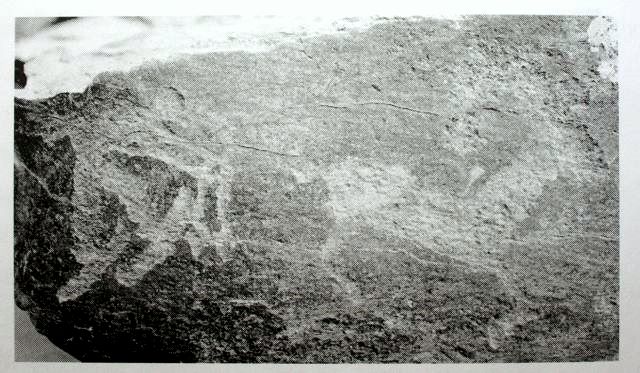
He couldn't pin down any specific reason, and didn't bother to repeat the official government line about preserving knowledge of ourselves. Instead, he offered: "It's something you can do where you can actually discover something. There aren't many ways to do that anymore." And that made sense to me. Alvin has fashioned a life that has supported his quest to climb new peaks, to plumb new caves, to ski new slopes no one else has tried before. It's his way of understanding the world, of ordering the universe. It's his religion, his science, his art, to orient himself bodily in places that reveal new views. Rock art sites provide him the opportunity to stand where others long past have been, and to see what they've seen in a time less obscured by civilization.
--William L. Fox, from The Void, the Grid, & the Sign, 2000
Photo credits:
Rock Carving Top
Rock Carving Bottom
Up in the Rockies, it was still winter. The slopes were open but the snow was receding. Kids begged their parents for a day off from school for one last boarding run. An Evangelical Christian junior talked her parents into letting her go the day before Mr. D's assembly. Cassie Bernall drove up to Breckenridge with her brother, Chris. Neither one had met Eric or Dylan yet.
--Dave Cullen, from Columbine, 2009
Photo credit
The standard Arlberg technique was used by Alf and Sverre Engen when teaching. I'd seen Sverre use the single dipsy in powder but Alf didn't use it in public because after all he was the head of the ski school! Junior Bounous, now the head of Snowbird's ski school, was an instructor under Alf Engen at Alta at the time we moved there in 1952. Junior refined the dipsy into what became the double dipsy--because the weight is on both skis. But there's still a definite bounce in it. Junior is the finest skier I've ever seen. He skis all techniques with equal facility. The tune he sings in really great powder is the old children's song: The worms crawl in, and the worms crawl out; they crawl right in and out of your snout. It's the perfect rhythm for steep powder.
--Dolores LaChapelle, from Deep Powder Snow: 40 Years of Ecstatic Skiing, Avalanches, and Earth Wisdom, 1993
Photo Credits:
Junior Bounous
Dolores LaChapelle
One of the men I skied with was Lefty Cormier, who had been in the Tenth Mountain Troops. He taught me the single dipsy. Few people could learn it because it violated all the skiing rules of the time. Those were the days of the Arlberg Technique, made famous by Hannes Schneider, in which the shoulders wrenched the skis through wide arcing turns. The single dipsy did none of that; but you did have to turn yourself over to the mountain in a way the skiers of that day couldn't handle. It turned out that learning this technique was the most important thing in my skiing life because it enabled me to turn where few could on steep narrow chutes between trees. Because of this rare technique I acquired a notoriety I didn't really want as a pulver schnee spezialist in Davos, Switzerland and later in Alta as the "best woman powder skier in the world."
-----------------------------------
Long before we ever got to Alta, way back in 1939, Dick Durrance was manager of the Alta Lodge. You must remember that at that time there were only two real ski resorts in the West--Sun Valley, begun by the Union Pacific Railroad to lure people to ride the train out west, and Alta. Durrance soon found that he could not ski the steep, narrow Alta chutes using the standard Arlberg technique; but because he was also a mountain climber and used to heeling down the steep chutes--that's the beginning of the single dipsy. Of course, through his winter at Alta he refined it some more.
------------------------------------------
To continue with the story of the single dipsy, the war had started in December, 1941, and the Mountain Troops were formed in spring of 1942. They trained at Camp Hale in a high valley near Climax, Colorado. Dev Jennings from Salt Lake, who skied at Alta, had learned the single dipsy from Durrance and he taught it to many of the men in his platoon the winter of 1942. My friend, Bob Swartz, who owns the Mountain Shop in Boulder, was in that platoon. In fact it is Bob who gave me the origin of the name "single dipsy." It's from an old popular song of the year 1937 called "The Dipsy Doodle." Another old climbing friend, John Devitt, a musician, wrote it out for me. It was sung by Edythe Wright on the original Tommy Dorsey record. Words and music were by Larry Clinton, a band leader.
The song started out with: The Dipsy Doodle's the thing to beware, The Dipsy Doodle will get in your hair. A couple of other lines relevant to the state of mind of powder skiing are: It's almost always in back of your mind. You never know it until it's too late...That's the way the Dipsy Doodle works. It's got a very bouncy rhythm. You can easily see why those mountain troop skiers back in the early forties picked that up as the name for their skiing style.
--Dolores LaChapelle, from Deep Powder Snow: 40 Years of Ecstatic Skiing, Avalanches, and Earth Wisdom, 1993
Photo Credits:
Drinker Durrance Graphics
It's like Mother Earth threw a quilt of beauty.
--Henry Barton Hatcher, 17 Nov 2010
Baby's younger Englishman had been chaperoning the women down appropriate inclines and harrowing them on the bob-run. Dick, having turned an ankle in a too ambitious telemark, loafed gratefully about the "nursery slope" with the children or drank kvass with a Russian doctor at the hotel.
"Please be happy, Dick," Nicole urged him. "Why don't you meet some of these ickle durls and dance with them in the afternoon?"
"What would I say to them?"
Her low almost harsh voice rose a few notes, simulating a plaintive coquetry: "Say,'Ickle durl, oo is de pwettiest sing,' What do you think you say?"
"I don't like ickle durls. They smell of castile soap and peppermint. When I dance with them, I feel as if I'm pushing a baby carriage."
It was a dangerous subject--he was careful, to the point of self-consciousness, to stare far over the heads of young maidens.
--F. Scott Fitzgerald, from Tender is the Night, 1933
Thanks for the tip, Jeff!
Unknown print found here.
They stopped for icicles to cool their drinks. Suttee clambered over a low stone wall and dropped into deep snow. Down the slope the firs stood black and brambly in their white shrouds and a fine mist of snow was blowing with a faint hiss like sand. He pissed a slushy yellow flower in the landscape, standing there with his drink in one hand, looking out on a wild white upland world as old as any thing that was and not unlike it might have looked a million years ago. Just when he would have said that nothing lived in these frozen altitudes two small gray birds flew. They came from a clump of snowbroken heather below and crossed the slope in a loping flight like carnival birds on wires and vanished in the forest.
He walked up the road, his shoes crunching in the packed snow. Under an overhang of icebound rock where sheer palisades of opaque crystal walled up the black forests above and he could hear the wind suck and moan in the trees. He reached to pluck small icicles from the rocks until he'd filled his glass with them.
Back in the cab she covered him with the blanket and rubbed his hands. You're icy cold, she said.
At Newfound Gap there were skiers, a bright group bristling with their poles and skis about the parked cars. They pulled in to watch them, goggled madmen in clouds of powder dropping down through the fir forests at breakneck speed. She clutched his arm, them standing there with their drinks and their breath swirling in the cold.
They went back in the early blue twilight, ghosting down the mountain with frames of snowy woodland veering inverted across the glass. They made love under the blankets in the back seat like schoolchildren and later she sat up and talked into the silent cabman's ear and made him promise not to tell what they had done and he said that he would not.
--Cormac McCarthy, from Suttree, 1979
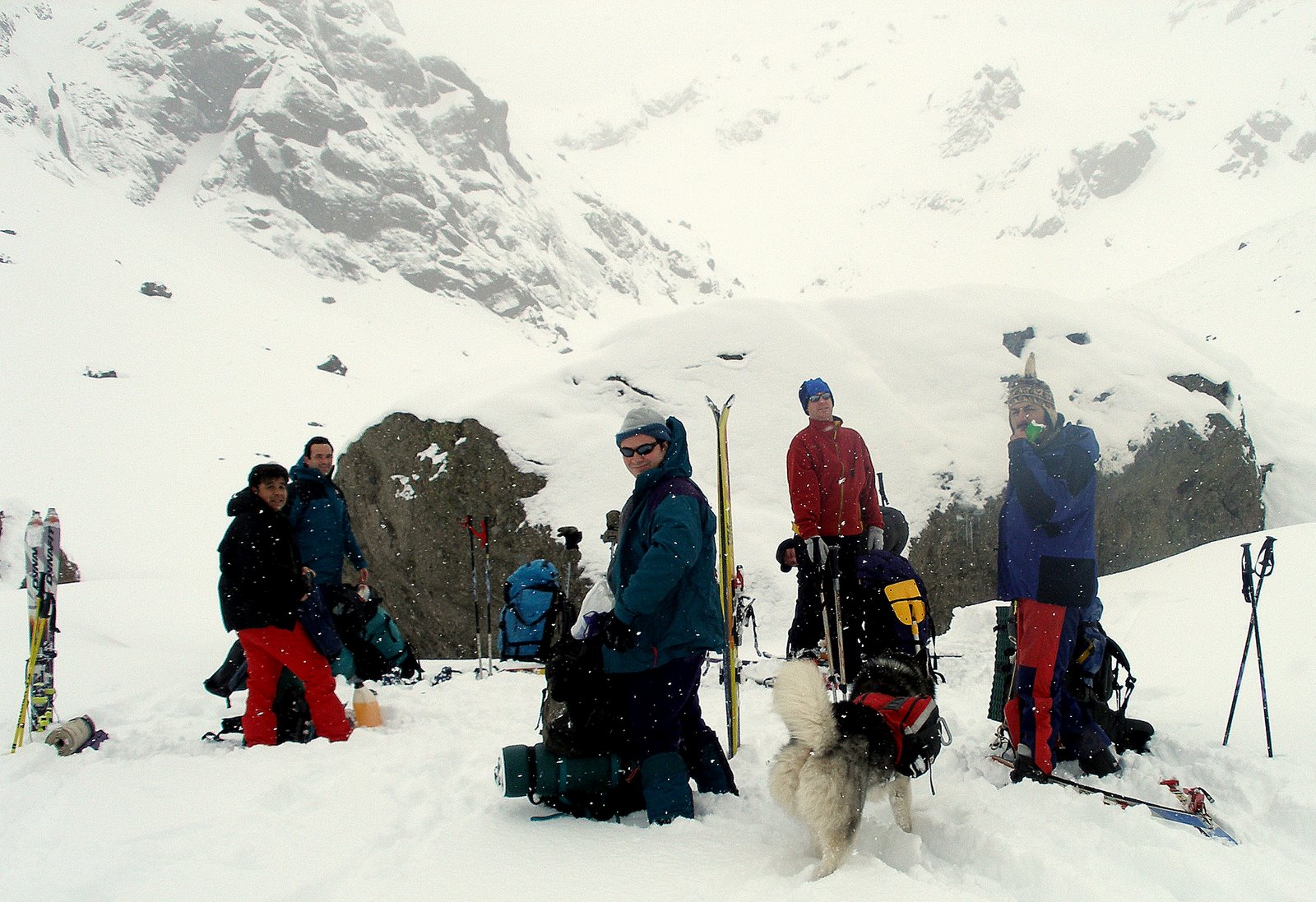
That afternoon he crossed the watershed and started down through a dark spruce forest. Ravens flew over the vast high country, the slopes falling away all heather and gray weather wood into the clouds below. He made a fire beneath a shelf of rock and watched a storm close over the valley down there, ragged hot wires of lightning quaking in the dusk like voltage in some mad chemist's chambers. Rain fell, leaves fell, slantwise and wild, a silver storm blowing down the eaves of the world. He'd found a few wild chestnuts and he watched them blacken in the coals. He cracked and cooled them. All things contained of tree therein, leaf and root. He ate. He'd no food other and he thought his hunger would keep him awake but it didnt. He could hear the long wild sough of the wind in the high forest as he lay there in his blanket staring up at the heavens. The cold indifferent dark, the blind stars beaded on their tracks and mitered satellites and geared and pinioned planets all reeling through the black of space.
In the morning there was snow at the higher elevations, a fairyland dust on the peaks. He had bound up his feet with the crokersack and now he simply wrapped the blanket about his shoulders and went down along the ridge, a hermetic figure, already gaunted and sunken at the eyes, a week's beard. Going shrouded in his blanket through the forest beswirled about by cold gray mist, gray weather, cold day, moss the color of stone. The wind sharp in the dry bores of his nostrils. Down through the pale bare bones of a birch forest where the claw-shaped leaves he trod held little ferns of ice.
--Cormac McCarthy, from Suttree, 1979
What's your ski house in Verbier like?
My house is small, a cozy chalet way high on the mountain. I love it - I've spent as long as six months at a time there. You know, Verbier has grown so much. When I came there in 1956 there were perhaps forty chalets and only two small hotels. Then the Belgians lost the Congo - and ever since, Verbier has been bulging with Belgians...bulging Belgians.
Verbier is infinitely better than St. Moritz or Gstaad. It's not chic, and it's not crowded. Gstaad is a joke. I often go to Gstaad because it's just across the valley. But Verbier has very long runs - I don't like to yo-yo, I don't like getting back up the mountain - and it is in sun all day long. Verbier also, unfortunately, attracts Italians. Last season I was hit by one. I was going slow - and this big Italian came around this turn...I don't think he had ever been on a pair of skis in his life...and slammed into me. I was black and blue for months.
Had you skied before your arrival in Verbier, before the Belgians and Italians had put out contracts on you?
My, I've skied just about everywhere - in Europe, in the United States, even in Japan. I've skied, you know, since I was twelve years old. I first skied in Colorado, with my father - who was then married to one or another of his seven wives. My father was mad about two things - motorcycles and Colorado. He loved Colorado. Steamboat is where we went, and I've been back there often. I've also skied at Vail, but Vail is Disneyland - it's not my kind of place.
I find skiing in Utah incredibly crude - it's like a second-rate boys' camp in the Adirondacks. All those Mormons running around in black clothes and black ties - it's like Chanel without jewelry.
The place I really like most is Sun Valley. And I like Grey Rocks in Quebec - but not in February. In fact, it's the coldest place I've ever been. When I was last there, I stayed for ten days - not for ten days of skiing but because I was so knocked out by the cold. I hate to ski in the cold.
The most interesting skiing I've found is in Japan, in Hokkaido. I love Japan, I love its cultural charm. The Japanese have more taste than the French - such attention to detail. When they do something, they do it right.
How do you see yourself as a skier?
I have the perfect body for skiing. I'm short, my balance is excellent, and I have two very strong legs, which I've developed really through swimming - I still swim two miles a day. I can do just about anything on skis. I have a tremendous amount of endurance. Most people I know think I'm a very good skier.
I have a certain element of - well, courage really. I do things on skis that other people won't do.
--Dick Needham, Truman Capote: An Interview, Ski, 1981
Photo credits:
Young Truman
Hans Castorp found that one quickly gets readiness in an art where strong desire comes in play. He was not ambitious for expert skill, and all he needed he acquired in a few days, without undue strain on wind or muscles. He learned to keep his feet tidily together and make parallel tracks; to avail himself of his stick in getting off; he learned how to take obstacles, such as small elevations of the ground, with a slight soaring motion, arms outspread, rising and falling like a ship on billowy sea; learned, after the twentieth trial, not to trip and roll over when he braked at full speed, with the right Telemark turn, one leg forward, the other bent at the knee. Gradually he widened the sphere of his activities. One day it came to pass that Herr Settembrini saw him vanish in the far white mist; the Italian shouted a warning through cupped hands, and turned homewards, his pedagogic soul well pleased.
---
He rejoiced in his new resource, before which all difficulties and hindrances to movement fell away. It gave him the utter solitude he craved, and filled his soul with impressions of the wild inhumanity, the precariousness of this region into which he had ventured. On his one hand he might have a precipitous, pine-clad declivity, falling away into the mists; on the other sheer rock might rise, with masses of snow, in monstrous, Cyclopean forms, all domed and vaulted, swelling or cavernous. He would halt for a moment, to quench the sound of his own movement, when the silence about him would be absolute, complete, a wadded soundlessness, as it were, elsewhere all unknown. There was no stir of air, not so much as might even lightly sway the tree boughs; there was not a rustle, nor the voice of a bird. It was primeval silence to which Hans Castorp hearkened, when he leaned thus on his staff, his head on one side, his mouth open. And always it snowed, snowed without pause, endlessly, gently, soundlessly falling.
--Thomas Mann, from The Magic Mountain, 1929
Photo credits:
Albert Meindl, Mountain Skiers, c. 1920
Ray Atkeson, Skier at Mount Hood, 1954
And what about Renée? The last words I heard directly from Renee were: Stop loving me. I suppose I shall never, never! fully recover from the pain of that separation.
Led by [a friend] we go high on the ridges of Teton Pass. Way up near timberline. Deep, soft snow. Trees shagged with snow, golden in the afternoon sun. We practice telemark turns -- too different -- I give up easily and contemplate the scenery. Suicidal plunges into the forest below. As always, I am consoled and comforted by the ready availability of death.
--Edward Abbey, Diary entry: 30 Jan 1980, Jackson Hole, Wyoming
Photo Credits:
Wyoming Department of Transportation
John Blaustein Photography
Thanks, Jeff, for the quote!
In a nutshell, Italy’s Val d’Aosta (most famous for Courmayeur and other ski areas) has one of the more storied vinous histories in Europe. Vines have been planted on the steep slopes of the region since before the Roman era and during the 1500s the red wine of Aosta was used in demonic exorcisms all the way to the Vatican. In a religious sense, the wine was revered for its deep sanguine appearance and meaty overtones - it was not sweet and easy to enjoy - exactly what the church was looking for. It smelled of evil things, which furthered the sense of purpose surrounding the exorcism itself. Today it smells the same but instead of “evil” we would call it heaven.
If the Belluard Les Alpes/Les Feu defines the Garagiste ideology from a white wine side of things, it could be argued that Les Crêtes does so from a red wine point of view as well. While Les Crêtes receives some of the more noteworthy critical praise in Italy for their white wines (among the highest rated in the country), it is their red wine that spills their soul. This is severe alpine wine - above tree level skiing with no maps or lifts in sight. You better have telemark skis to navigate your way down as Les Crêtes insures their wine is full of twigs, rocks, billy goat droppings, hiking boots, alpine flowers, and one of the most intense aromatics of varietal sauvage you will encounter. Think Ampuis (not Guigal but artisinal Ampuis) meets Taurasi with snow chains and studded tires inching their way over the mountain pass - no railings and a sheet of solid ice. There is no room for error and the journey is miraculous and precarious. When you make it over the top (or to the ski area parking lot) you feel a sense of winning a battle with the elements but a sense of anticipation as to the days fresh tracks that lie ahead in 12-inch deep powder. If you could bottle the wild ride above with all the scenery, smells and death-defying battle of the wills between your own ability and nature’s determination to disallow your every movement - it would be Les Crêtes and this wine in specific.
--Jon Rimmerman, Garagiste Wine
Photo credits:
Les Crêtes
We felt our first tremor when the Chileans came barreling down our driveway in a borrowed Jeep, gears screaming, doing 50 in low gear. When they alighted we found them Latin to the core. They also possessed the very peculiar Latin death wish: they drove cars with feckless abandon and no regard for vehicular law, skied with an unconstraint that sent hackers scrambling for the trees, kissed every woman in sight (even if she looked like a hamster and was pushing seventy), woke guests singing loudly of heartbreak nights and joy-filled days.
Their battle cry, I'll tell you right off, was later banned from the Olympic site. Imagine, if you will, a sound composed of equal parts Yma Sumac, Comanche war cry, and the screech of tearing metal, and you have it. The cry originated with the boy Indio, who was not your routine Portillo or Santiago Chilean. He sprang from somewhere high in the Andes, was pure, unadulterated Incan, and didn't even speak Spanish.
Actually, Indio never spoke at all. He just looked alert, his button-black eyes moving from face to face and marking every exit. When Indio had needs the other boys divined them, probably through osmosis, and if he wished to vent a feeling or two, he simply broke into the high, mournful wail of the battle cry. Indio in full voice could single-throatedly set off an avalanche.
My mother arrived for her first visit from the East in time to hear The Cry issuing from forty throats in the upstairs lounge - the guests had picked it up in sheer self-defense - and immediately took to her bed with a three-day sinking spell and without, as I sniffled to Iglook, "...even one glance at our view!"
The Chileans plummeted up and down our driveway and all the ski runs, spilled hot wax the length and breadth of our dorms, used my steam iron to press their skis, leered shamefully at our prepubescent daughters, and triumphantly presented me with a housegift bouquet of live, unplucked chickens they'd wheedled out of a local rancher. The children, meanwhile, picked up a lot of Spanish, most of it unacceptable in polite homes, and followed the team everywhere. It was influences such as this which led to Dan, at the age of three, traveling the chairlift to 11,000 feet while his father and I rested secure in the thought that he was safely enrolled in kiddies' ski school down below.
The Chilean National Team may not have won any medals at Squaw Valley, but they sure left a lasting impression in Aspen.
--Martie Sterling, from "Life with Stein, Leon, and the Chilean Crazies," Ski Magazine, 1977
(Gracias, Andi, por permiso. Besos y abrazos también.)
Andy and I never skied together. But I did see Andy ski once. I'd tagged along with a pack of Wolf Creek ski instructors out to Montezuma Bowl, the plunging undercup of twelve thousand foot Alberta Peak. Chutes streaked down the mountain wall like white war paint. The ski conditions were typical: post-storm crud that had been skied to an al dente wicker, still soft enough that knee-deep blocks splashed open like loose hay bales. One at a time, we all scribbled our little ant farm paths to the bottom, stacking short turns tight as puka shells. Andy came last. His turns swaled the entire width of a chute. I could see why he'd waited. He needed the rest of us out of the way. At the end of the first turn, he half-hopped, changed direction, hooked his skis back into the checkered snow and eyelinered across the entire concave of the slope--like a skateboarder accelerating in the deep end of an empty swimming pool. Another hop brought him to rest in the avalanche tailings where the group had bunched up to bitch about the chunky conditions.
I was impressed. Once on the boards, Andy--land-ethicist, eco-wonk, solo-trekker, Outward Bound-geek--had an inner Errol Flynn. Those long, pendulous garlands weren't bail-outs. There were high speed, chin-out, suspension bridge, Dick Durrance, lace 'em up, cable binding, Tuckerman's Ravine classics. The way Andy skied it, the inconsistent snow looked like good surf. I couldn't help thinking, Why didn't I do that?
"Nice turns, Andy," I said. "All three."
"Actually, four," Andy said, "if you include stopping."
--Wayne K. Sheldrake, from Instant Karma: The Heart And Soul of a Ski Bum, 2007
(Lea's pics. Thanks Lea.)
But if the tourists ever discover in numbers the back country that lies behind the loop of national parks and monuments, if they ever by any chance get up on Thousand Lake Mountain or the Aquarius Plateau, if they ever make their way into the Colob up from Zion, if they discover the permanent wilderness in the Grand-daddy Lakes Basin in the Uintahs, if the promoters ever succeed in exploiting to the full the skiing at Alta, that old sinful ghost town in Little Cottonwood Canyon where the United States Army trained para-ski troops during the winter of 1941, the valleys of the mountains are no longer going to provide sanctuary.
--Wallace Stegner, from Mormon Country, 1942
Photo Credits:
Alta City
Alta Postcard
$5,900,000 Alta Home
The Cliff "Lodge"
Nowadays the meadow isn't considered worth haying. Machinery is cost-prohibitive in relation to annual yield. No one will winter here anymore. We are a different breed of Westerners. Snow always looks good to skiers.
Someone from Denver bought Lyle's place for the fishing, a summer retreat. Without irrigation much of the meadow has regressed to native sidehill pasture and sage. The rest is frumpy-looking, matted under the yellow thatch of last year's uncut growth. Along the east fence, where Pat and Lyle used to bet on whether or not the snowdrift would last till the Fourth of July, short lengths of snowbroken wire sink into the earth, sink down with the roots.
Underneath its feral pelt, the meadow is still the meadow, entire, lying in wait for winter. Wildflowers still joy in its swells and hollows. And do the ruined, sage-choked irrigation ditches feel sorry for their intricately pattered uselessness?
--James Galvin, from The Meadow, 1992